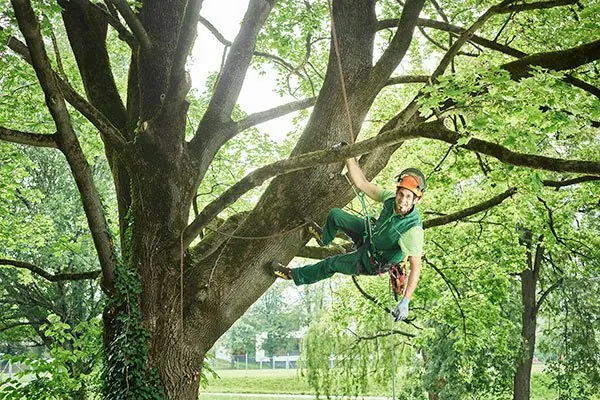
The cyclone season in Far North Queensland runs from November to April. Getting trees ready means checking them in the dry months, removing dead wood and obvious defects, cleaning palms, reducing excessive weight over buildings, and dealing with trees that are already failing. Doing that in the dry season is cheaper, safer and easier to book than waiting until a cyclone watch is issued.
This guide is for Cairns homeowners and landlords, from the beachside suburbs to the hills and the cane-belt towns. It covers what to look for, which trees and palms deserve attention first, how to avoid pruning that makes a tree more dangerous, and what to do after a storm.
The calendar that matters
Tree preparation in Cairns works best when it follows the seasons rather than the weather forecast.
| Months | Season | What to do with trees |
|---|---|---|
| May to July | Early dry | Walk the yard, list concerns, book an arborist to look. |
| August to October | Late dry and build-up | Pruning, palm cleans, removals and stump work while ground is firm. |
| November to April | Wet and cyclone season | Keep an eye on changes after heavy rain; urgent make-safe work only. |
The official Australian tropical cyclone season runs from 1 November to 30 April. Cyclones can and do form outside those dates, and severe thunderstorms in the build-up can also bring down limbs, so finishing major tree work by the end of October is a sensible goal.
Why the timing is not just about weather
In the dry months, ground is firm enough for elevated work platforms, chippers and stump grinders to drive in without ruining lawns. Contractors have more availability. If pruning shows a bigger problem, there is time to arrange removal. Leaving it until November means competing with everyone else who looked at their trees after the first cyclone watch.
Why Cairns trees fail in storms
Most trees that fail in cyclones do so in one of three ways:
- Branch failure. Dead, decayed or poorly attached limbs snap off. This is the most common problem and the easiest to reduce with pruning.
- Stem failure. The trunk or a main fork splits, often at a pre-existing crack, cavity or tight V-shaped union.
- Root plate failure. The whole tree tips over, roots and all. This is especially likely when soils are saturated after days of rain, and it is where the wet season makes Cairns different from drier cities.
Saturated soil loses much of its grip on roots. A tree that would have stood through strong wind in dry soil can go over in the same wind when the ground has been soaked for a week. Trees on poorly drained flats, beside drains and creeks, or with roots damaged by trenching, paving or building are most at risk.
A walk-around checklist
Walk around every significant tree on your property in daylight. Look up, look at the trunk, and look at the ground.
In the canopy
- Dead branches: no leaves, bark peeling, or a different colour to the rest of the crown
- Hanging or broken limbs caught in the canopy from previous storms
- Long, heavy limbs extending over the roof, carport, pool or a neighbour's house
- Very dense crowns that block light and wind completely
- Branches touching the roof, gutters or the service wire to the house
On the trunk
- Cracks or splits, especially running down from a fork
- Tight V-shaped forks with bark pinched between the stems
- Cavities, soft wood, oozing, or fungal growths such as brackets or mushrooms
- Old wounds from previous lopping that have not closed
- Termite mud leads running up the trunk
At the base and ground
- A lean that is new or has increased
- Soil cracking, lifting or mounding on one side of the trunk
- Roots that have been cut by trenching, driveways or building work
- Mushrooms or fungi around the base
- Water pooling around the tree after rain
If you see any of these, get an arborist to look at the tree. Some are minor and easily fixed; others mean the tree should come down before the wet.
Species that need a closer look
Every species can fail. Some come up again and again in north Queensland storm reports and in calls after severe weather.
African mahogany. Widely planted as a shade and street tree across the north. It grows into a large, dense, heavy crown and has a reputation for dropping big limbs and going over in strong winds. If you have one close to the house, have it assessed and ask whether reduction is enough or removal is safer.
Weeping fig and other large figs. Vigorous, with heavy horizontal limbs and very dense canopies. Their shallow, spreading roots often run under paths and slabs, and root damage from building work can weaken them.
Raintree. A broad, umbrella-shaped crown that catches wind. Long lateral limbs over houses and driveways are often worth reducing.
Mango. Generally sturdy, but old backyard mangoes accumulate long, heavy limbs and dead wood. Thinning and end-weight reduction help.
Poinciana. Wide crowns and brittle timber; branch failure is common in strong wind.
Umbrella tree. Fast, weak growth and a tendency to self-seed into poor locations. Often worth removing rather than pruning.
Native trees such as paperbarks and some eucalypts generally cope with wind better, but they still accumulate dead wood and should be checked. Before major work on native vegetation, check whether any overlay applies to your property.
Palms before the wet
Palms often handle wind better than broad-crowned trees, because their flexible trunks and fronds bend rather than catch. But they can still cause damage:
- Coconuts can become dangerous in strong wind, and even in normal conditions they fall without warning.
- Dead fronds hang on until wind tears them loose, then fly.
- Seed stalks on foxtail and royal palms are heavy and drop with force.
- Tall, leaning palms over houses or pools are worth assessing, especially if the base has been damaged.
A palm clean before November removes the loose material without harming the palm. Ask for dead fronds, nuts and seed stalks only; stripping green fronds weakens the palm. For more, see our page on palm tree lopping and removal.
Pruning that helps and pruning that hurts
Good preparation pruning aims to reduce the chance of failure without damaging the tree. That usually means:
- Removing dead, broken and diseased wood. This is the simplest and most valuable step.
- Reducing end weight on long limbs, especially over structures, by cutting back to a suitable lateral branch.
- Selective thinning of very dense crowns so wind can pass through, without removing so much that the tree is stressed.
- Clearing roofs and gutters and keeping limbs off the service line, with the line itself left to someone authorised.
What hurts is heavy topping or "hat-racking": cutting the whole crown back to stubs. In the tropics, a topped tree responds with a dense mass of fast regrowth. Those shoots are weakly attached and, within a season or two, can be more dangerous than the original crown. Removing too much foliage can also stress a tree and make it more vulnerable to decay.
A good arborist will explain what they plan to cut and why. If a quote simply says "lop tree", ask what that means in practice. Our tree lopping page has more on the cuts to ask for.
Other things to sort before November
- Gutters and roof. Clear leaves and fronds so water can drain in heavy rain.
- Loose garden material. Old logs, palm fronds and branches lying around can be picked up by wind. Get rid of them.
- Power lines. If trees are near the street lines, report it to Ergon Energy. Do not prune near lines yourself.
- Neighbours. If a neighbour's tree worries you, talk to them early. Queensland's Neighbourhood Disputes (Dividing Fences and Trees) Act 2011 sets out the process if you cannot agree.
- Insurance. Check what your policy covers for tree removal after a storm, and keep photos of the trees and property before the season.
- Emergency plan. Follow Cairns Regional Council's and Get Ready Queensland's advice for household cyclone preparation.
After a cyclone or severe storm
Safety comes first.
- Stay inside until official advice says it is safe.
- Keep away from fallen or sagging power lines and anything touching them. Call 000 if anyone is in danger and report line damage to Ergon Energy.
- Do not walk under damaged trees. Hung-up limbs can fall without warning.
- Photograph damage to the house and property before anything is moved, unless waiting puts someone at risk.
- Call your insurer before arranging major tree work where possible.
- Get trees assessed before cutting. A tree that looks bad after a storm may be saveable with pruning; one that looks fine may have a cracked root plate. An arborist can tell the difference.
After major events, contractors are swamped. Jobs where a tree is on a house or blocking access get priority. Trees that have dropped a few limbs in the garden can usually wait for a proper assessment rather than a rushed cut.
Green waste after the season
Large volumes of green waste follow big storms. Council usually advises how storm debris will be handled after a major event, so follow their instructions. Parts of Cairns have been subject to biosecurity controls for electric ants, which can restrict moving green waste, mulch and soil out of affected areas. Check whether your address is included before moving material.
Book the look now
The single best thing you can do is have someone look at your trees during the dry season. Call (07) 4064 9207 or use the form below to arrange a free on-site quote. For prices, see our Cairns tree work cost guide, and for removals, read about tree removal in Cairns.